 Lutenant
Property agent platform
An independent property consultant wanted to represent buyers properly, without drowning in listings, spreadsheets and email. Lutenant designed, built and runs the platform that does it (client name withheld ahead of public launch).
since 2 Nov 2026
on every release
translated listings
The problem
International buyers relocating to a new market need someone on their side. Doing that well meant juggling homes spread across dozens of agency websites, each in its own format; the same house listed by several agencies at different prices; and each buyer's wishes, shortlist and viewings kept by hand.
The work that earns the fee, finding the right home and negotiating for the buyer, was being squeezed by the admin around it.
What was built
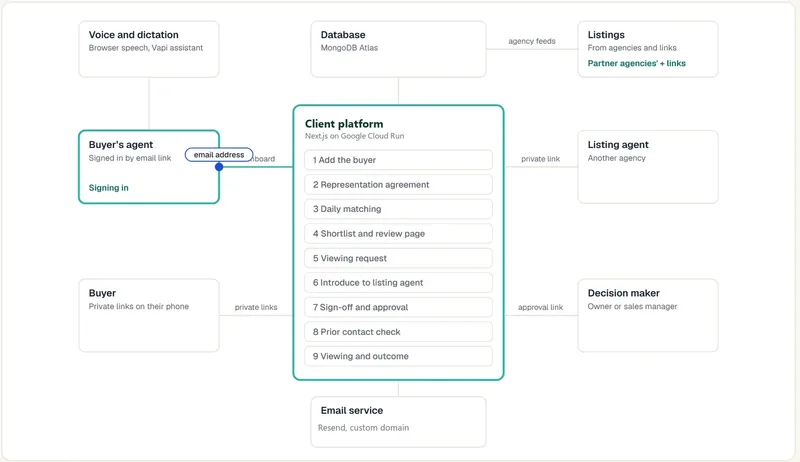
- One place for every buyer: their search, shortlist, viewings and introductions, with website enquiries and voice-dictated briefs turned into buyer records in one step.
- Listings from partner agencies: read from partner agencies' own websites each night with full photo galleries, sold homes filtered out, and the same home listed twice shown once.
- Introductions that are tracked: from the first introduction, fee sign-off and prior-contact check through to the signed promissory contract and commission received.
- A monthly report to each partner agency, partner agreement links, and a dashboard showing how the business is doing.
- Six languages (English, Portuguese, French, German, Dutch and Spanish), with on-demand translation of property titles and descriptions.
How it's built
The same way I built platforms at Amazon and MongoDB, scaled to a small business:
- Runs on Google Cloud with a managed MongoDB Atlas database, so there are no servers to look after.
- Each agent can only ever see and change their own records.
- 1,080 automated checks run before every release.
- Released in small, frequent versions: 85 versions live since 2 November 2026.
Where it stands
The platform went live in November 2026 and is in its first phase: onboarding partner agencies and taking its first buyers through to a sale. This page will be updated with results as they come in.
Have work like this in your business?
A 30-minute call, no pitch. Tell me where the hours go and I'll tell you honestly whether AI can help.